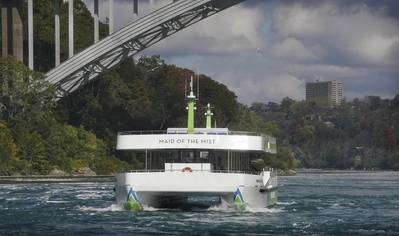
Marine News’ Top Boats of 2020: James V. Glynn and Nikola Tesla
1/4/21
Christopher Glynn had known for some time that he wanted to build all-electric vessels for his Niagara Falls tour boat company Maid of the Mist. In January 2018 he decided in earnest that he was going to make it happen.
But where to begin? Fully electric ferries had never been built in North America, so Maid of the Mist would be plying uncharted waters. Glynn, the companyâs president, said he and his team started by doing their researchâa lot of researchâand by hiring a team of consultants to help weigh their options.
Inspired by the worldâs first all-electric ferry, Norledâs Ampere in Norway, Glynn knew his team could bring the innovative and emissions-free technology stateside. âWe were very excited and intrigued by the opportunity,â Glynn said. âWe knew it wasnât going to be easy, but it could be done.â
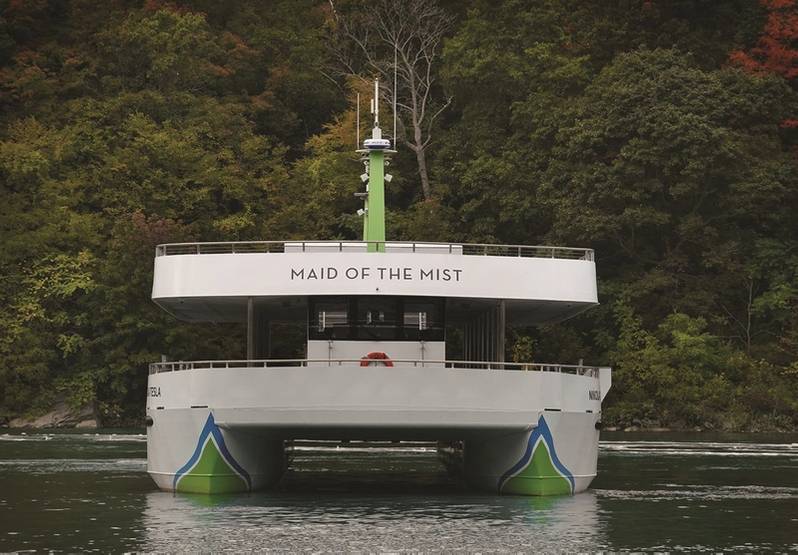
And so began the pioneering journey to design, build and commission Americaâs first newbuild all-electric passenger vessels, James V. Glynn and Nikola Tesla. The first-of-their-kind vessels entered service in October, each with capacity to carry up to 600 passengers to experience one of North Americaâs most well-known natural attractions. Notably, the vessels are all-electric, not hybrid, meaning thereâs none of the exhaust fumes, engine noise or vibrations associated with diesel engines, Glynn said.
In addition to their environmental credentials, the manner by which these vessels were built also makes them quite unique. The 90.5-foot aluminum catamaran vessels were designed by John Koopman, president of Propulsion Data Services, and constructed modularly at Burger Boat Company in Manitowoc, Wis. Each section was trucked to Niagara Falls where the modules were lowered by crane into the gorge and pieced together at Maid of the Mistâs facility where they were also outfitted.
âIt canât be overstated how difficult it was to get the boats assembled down in the gorge,â Glynn said, adding that the U.S. Coast Guard approval process, which he described as ârigorous, and rightly soâ, posed additional challenges. Glynn said Micah Tucker of Tucker Yacht Design was instrumental in helping Maid of the Mist to navigate this hurdle and other aspects of the project.
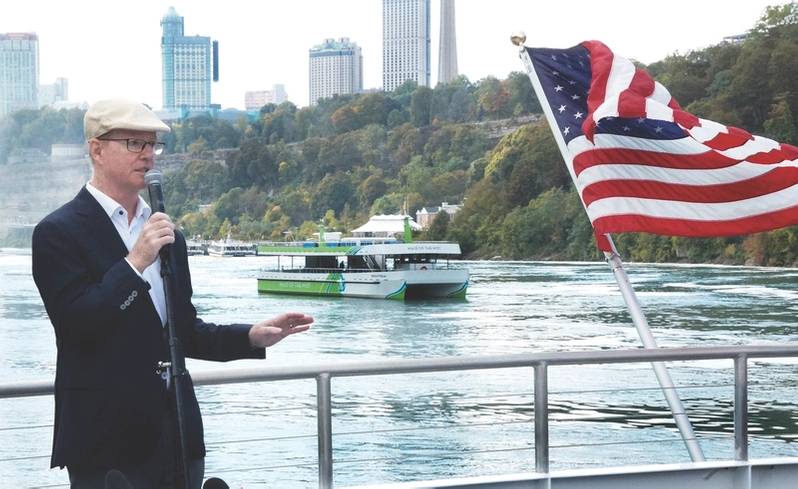 Maid of the Mist President Christopher M. Glynn
Each vessel receives power from a pair of Spear Power Systems lithium-ion battery packs providing 316 kWh total capacity divided across two catamaran hulls. The battery banks power vertically mounted Ramme electric motors that drive Veth azimuthing L-drives and Naiad Dynamics bow thrusters. ABB engineered the electric power management system and supplied critical components, including manual Cavotec ship-to-shore battery charging connection that can replenish the batteries in seven minutes during the disembarkation and boarding period between voyages. ABB also supplied a scope of electric, digital and connected solutions including switchboards, drives and the integrated control system, in addition to a remote diagnostic system for monitoring and predictive maintenance.
Ed Schwarz, ABBâs vice president of sales, newbuilds, said the operational profile of the Maid of the Mist vesselsâfrequent and relatively short trips and docking timesâis particularly well suited for all-electric propulsion. âWe were able to fit enough battery power and have a completely redundant system that freed the vessels from having to have engines on board,â he explained.
The vessels, which run trips that are typically about 20 minutes long, are charged using locally produced hydroelectricity, ensuring that the energy cycle for the operation of the Maid of the Mist ferries is entirely emissions-free. âItâs an ideal state thatâs not always possible, but when it is, itâs really a home run,â Schwarz said.
The vessels draw additional benefits from the thrusters, said Tim Batten, vice president, sales at Vethâs parent company, Twin Disc: âHaving azimuth thrusters allows the Maid of the Mist vessels to have great maneuverability so that the captain can get passengers close to the sights of Niagara Falls.â
Batten said the L-drives also increase efficiency, help to save onboard space and give passengers a more exclusive experience to take in the sounds of the towering falls. âBoth thrusters are completely isolated from the aluminum hull with a resilient mounted thruster suspension in order to reduce noise and vibration transferred to the hull. The prime movers are permanent magnet motors connected directly to the azimuth thrusters, and L-drives are a good fit for this application because it has one less gear set than a Z-drive, so it is more efficient due to lower gear transmission losses,â he said.
Recent Comments