New York’s highest court rules in favor of Maid of the Mist
4/9/15
On April 2, 2015, the New York State Court of Appeals, New Yorkâs highest court, ruled in favor of the Maid of the Mist, dismissing a lawsuit filed in 2012 by Hornblower, which had challenged the Maid of the Mistâs right to construct a maintenance and storage facility on the U.S. side of the Lower Niagara River.
This essentially ends the case, since there should be no further opportunities for appeal. The U.S. Supreme Court can hear cases from the highest courts of the states, but the issue must be constitutional. There were no constitutional issues in these cases.
âFrom the start, it was evident there was no basis for this case, and at every level, the courts agreed,” said Christopher Glynn, Maid of the Mist president. “The courts were never swayed by baseless claims that the plaintiffs were prepared to pay more for the U.S.A. contract. For the Maid of the Mist, it is now clear sailing as we prepare for another successful season, providing guests from around the world with a monumental experience that is only available in the U.S.A.â
It is important to reiterate a number of salient points:
Effective in February, 2003, Maid of the Mist entered into a 40-year license agreement with New York State Parks for the exclusive operation of boat excursions on the Niagara River, retail sales in a gift shop, and operation of the Observation Tower. The license agreement was signed by State Parks and, pursuant to New York law, was reviewed and approved by each of the New York State Attorney General and the New York State Comptroller.
The New York State Comptroller has consistently taken the position that revenue contracts are not subject to New Yorkâs competitive bidding laws.
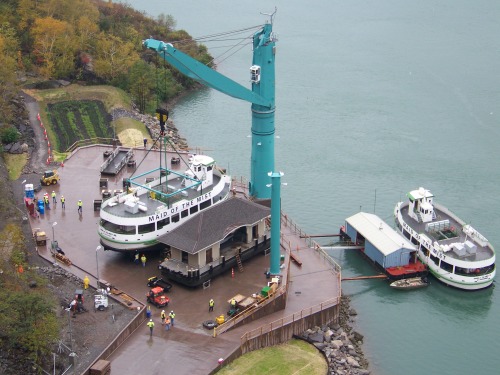
In February 2013, State Parks and Maid of the Mist signed an amendment to the license agreement for the construction of a dry dock in Niagara Falls, New York, and changes to the financial terms of the license agreement. Following New York law, this amendment was reviewed and approved by each of the New York State Attorney General and the New York State Comptroller.
The dry dock was paid for by Maid of the Mist, but is owned by New York State.
The amendment was supported by many levels of government, including the City of Niagara Falls, New York State and federal agencies.
State Parks has, in writing, recognized that (a) the license agreement remains in effect until 2043, (b) Maid of the Mist has complied with all contractual requirements of the license agreement and has not been in breach of the license agreement, and (c) premature cancellation by State Parks of the license agreement would constitute a breach of contract by State Parks, making it liable for damages to Maid of the Mist.
State Parks has, in writing, determined that, âHornblower is simply behaving as would be expected of a self-interested private corporation, seeking to eliminate its competitor and favorably position itself for future negotiations with State Parks for the resulting business opportunity.â
Hornblower has made repeated statements that it is willing to pay State Parks more than Maid of the Mist is obligated to pay State Parks for the operation of the tour boat concession. In response to such statements, State Parks has stated in writing that such claims are âentirely speculative, as the agency has no basis to consider other potential vendors while a valid License with the Maid is in place. We also note that Hornblower has denied requests from State Parks to provide a copy of its contract with [Niagara Parks Commission] to provide tour boats from the Canadian side of Niagara Falls, maintaining opacity as to those business terms and, therefore, preventing an independent assessment.â
In March, 2013, petitioner Hornblower commenced a lawsuit against Maid of the Mist, New York State Parks, New York Power Authority and others. In the lawsuit, Hornblower asked the trial court to (1) declare the amendment (and, as a result, the 2003 agreement) illegal and void and (2) enjoin performance of the amendment. The Trial Court issued a decision denying all of the relief requested by Hornblower and dismissing Hornblowerâs lawsuit in its entirety. Hornblower appealed the Trial Courtâs decision to the New York Appellate Division, Fourth Department. The Fourth Department unanimously affirmed the decision of the Trial Court. Due to the fact that the decision of the Fourth Department was unanimous, Hornblower has no automatic right to further appeal the decisions of the Trial Court and the Fourth Department. Hornblower filed a motion with the Appellate Division seeking leave to appeal to the Court of Appeals and that motion was denied.
There has not been a single ruling in favor of Hornblower at any level or by any court.
Recent Comments